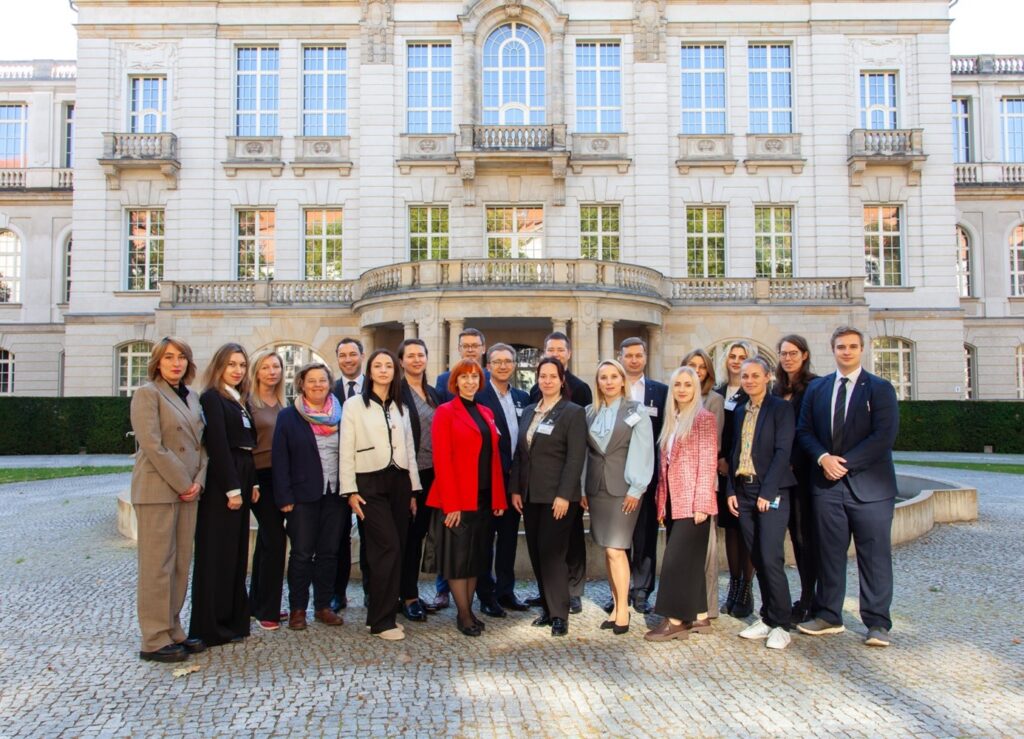
In August 2025, this year’s training programme for senior staff of the Ukrainian Government began with a record number of 40 applications and an intensive selection process. 15 participants from key Ukrainian Ministries who are working on the implementation of EU requirements and the steering of reform processes in light of the country’s EU membership aspirations were selected.
Mariia Hrebeniuk, senior staff member in the division for international cooperation and European integration at the Ministry for Development of Communities and Territories of Ukraine, said: “I applied for the training programme because I am very interested in the EU integration process. I would like to learn more about the challenges of this process – especially about how a country like Germany with much experience dealt with it.”
Veronika Goritska, deputy head of a group in the division for business development at the Ministry of Economy, Environment and Agriculture of Ukraine, said: “We in Ukraine are on the path towards EU integration. It is therefore important for us to understand the responsibilities and roles of the different EU institutions and in the Member States like Germany. After the training programme, I want to pass on this knowledge to my team.”
These are examples of the expectations of the selected participants at the start of this year’s programme cycle. The programme consists of several training courses – both as virtual events and in presence – and a two-week study tour to Berlin.
What is the Ukraine training programme?
The training programme for senior staff of the Ukrainian Government was launched by the German Federal Government back in 2001 at the initiative of the Ukrainian Government. Funding for the programme is provided by the Federal Ministry for Economic Affairs and Energy. Since the launch of the programme, 23 programme cycles have taken place, in which more than 300 civil servants of the Ukrainian Government have participated.
The programme aims to equip Ukrainian civil servants with skills to support Ukraine’s intended accession to the EU and the related reform processses. This is to promote a better understanding of European processes and cooperation with the EU. The programme is an important contribution to Ukraine’s alignment to the EU and to cross-border administrative cooperation.
The central element of the training programme is a two-week study tour to Berlin with practical expert talks on cooperation with EU institutions and the EU integration process in German Ministries. The programme is complemented before and after the study tour by practical training courses on key vocational qualifications and on Germany’s political system.
Since 2025, the division “international administrative partnerships (incl. EU twinning) and government consultancy” (EB6) has been responsible for the programme within the Federal Ministry for Economic Affairs and Energy. Within division EB6, the coordination office for institutional partnerships is in charge of the project, which is being managed by the Deutsche Gesellschaft für Internationale Zusammenarbeit (GIZ).
The first training course took place in Kyiv on two days in August. It provided an opportunity for the participants to compare the structures, responsibilities and activities of German and Ukrainian Ministries and analyse the bilateral cooperation between the two countries. A further virtual training module on “intercultural management” in September focused on understanding the differences regarding ways of communication and decision-making processes.
Study tour to Berlin from 27 September to 12 October 2025
The key element of the training programme, namely the two-week study tour to Berlin with practical expert talks on cooperation with the EU in German federal institutions started on 27 September 2025. Over seven days, the participants visited twelve federal institutions.
The first one was the Federal Ministry for Economic Affairs and Energy. The issues included the tasks of the Ministry regarding Germany’s European policy, bilateral economic relations between Germany and Ukraine, and coordination with the EU in light of the current challenges in the field of multilateral and bilateral trade policy. In addition, specific instruments were presented which can support the EU candidate countries in the integration process, including twinning and administrative partnerships. The German instrument of the promotion of foreign trade and investment and the self-governing system of companies in Germany were further topics. Further priority issues of the talks were the Energy Partnership and European energy policy – which are key for Ukraine, but also for Germany, in the current geopolitical situation.
During the study tour, the following institutions were also visited: the Federal Chancellery, the Federal Ministry of Labour and Social Affairs (BMAS), the Federal Ministry of Finance (BMF), the Federal Ministry for Economic Cooperation and Development (BMZ), the Federal Foreign Office (AA), the Federal Ministry of Transport (BMV), the Federal Ministry of Justice and Consumer Protection (BMJV), the Bundestag administration, the Bundesrat, the Office of the Federal President and the Federal Press and Information Office.
The issues discussed included the central tasks of the Ministries relating to the EU, the coordination processes, and the communication with the EU and within Germany on EU policy and the implementation of EU Directives by way of specific practical examples.
The Federal Ministry of Justice and Consumer Protection, for example, presented the case study of the implementation and the resulting specific challenges of the EU Late Payment Directive in Germany – a Directive which is currently being worked on in Ukraine. The discussions in the Federal Ministry of Finance focused on the Economic and Financial Affairs Council (ECOFIN Council) and European requirements regarding government borrowing, EU membership contributions and budgetary planning.
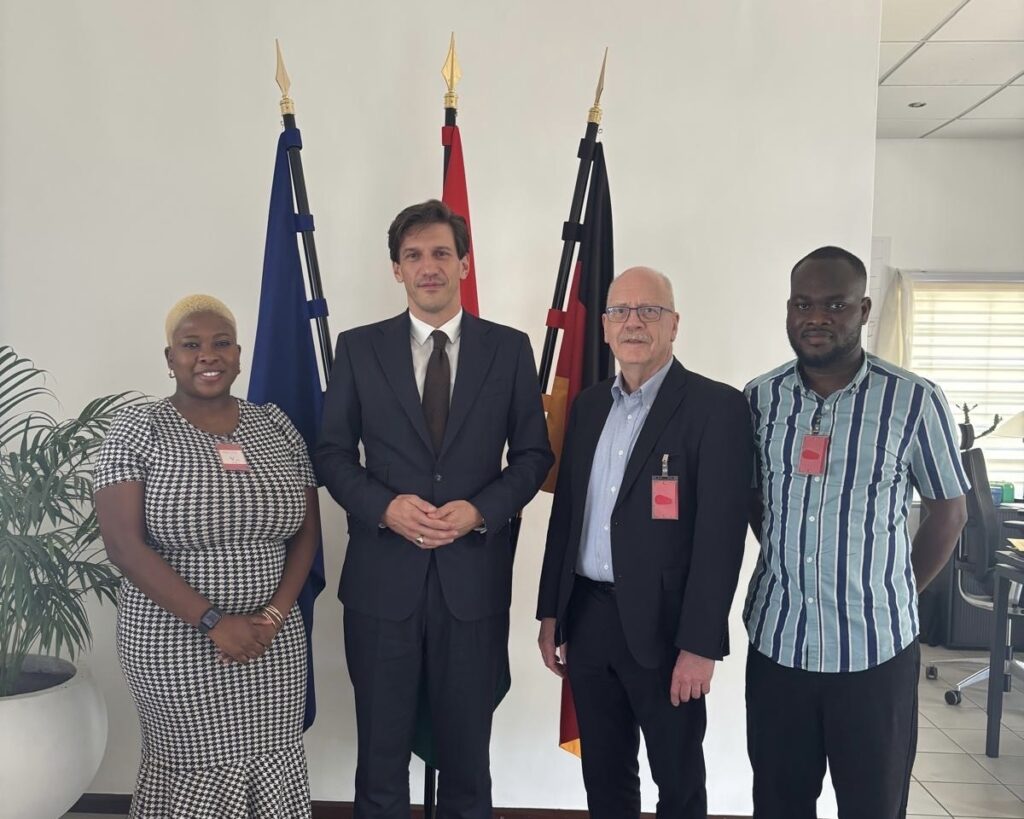
The intensive expert dialogue in the Federal Ministry of Labour and Social Affairs on labour and wage policies in Germany and on the alignment of standards in Ukraine was followed by talks between the Ministry’s staff members and Kateryna Astakhova, deputy director-general at the Ministry of Economy, Environment and Agriculture of Ukraine. Apart from the exchange on specific labour-market issues, the talks provided an opportunity to establish important contacts for the current administrative partnership between the Federal Ministry of Labour and Social Affairs, the Federal Ministry for Economic Affairs and Energy and the Ukrainian Ministry of Economy.
Yuliia Tyshko, senior staff member in the division for notifications at the Ministry of Economy of Ukraine, said: “The programme is tailor-made so that all of our specific questions could be answered. “Every Ministry offered possibilities for us to ask many questions about the EU integration, for example how individual requirements have been met and what challenges Germany had faced.” Veronika Goritska said: “We are determined to translate these findings into practice in Ukraine.”
In addition to the expert talks, there were onsite training courses on the issues of “communication and presentation”, “leading negotiations” and “leadership”. The modules were interactive and practice-oriented, with examples, exercises, video feedback and intensive group reflection. A special emphasis was placed on ensuring that the training was particularly relevant for real situations.
Veronika Goritska said: “You cannot lead a team without soft skills. No matter how much knowledge you have, it is impossible to communicate with a team and attain objectives without the development of soft skills. In the context of this training programme, we exercised the negotiating process and various communication instruments. I believe that the combination of advanced training through the expert talks with representatives of the Ministries and the development of soft skills is very useful. This makes the training programme so unique.”

The 2025 programme cycle was concluded with two further online training courses in November – after the return of the participants to Kyiv. The course focused on the issue of “resilience and steering in times of war”. The two modules were regarded by the participants as valuable elements to rethink personal patterns of behaviour and internalise the new insights gained in Berlin.
Have the participants’ expectations been met?
Veronika Goritska said: “It was a very successful combination of meetings with experts in all the Ministries and training courses, together with a cultural programme. We had the opportunity to discover Germany. We are grateful for the openness of the colleagues in the Ministries and for the practical advice. This includes the psychological training modules, the wonderful words of the people we met, the networking and the contacts – and the openness and transparency of the German Federal Government.”
Mariia Hrebeniuk said: “The colleagues in the Ministries were very open and friendly. Germany stands with Ukraine – this is what they made clear to us. The programme was homogeneous – it has exceeded our expectations.”
From the German point of view, the networking between German and Ukrainian colleagues resulting in particular from the study tour strengthens the institutional and political cooperation between Germany and Ukraine. At the same time, the programme supports the interest of the German Federal Government to improve the long-term framework conditions for economic cooperation and business relations of German companies with Ukraine.
Enjoying a very high reputation among the Ukrainian Ministries, the programme makes a very important contribution to Ukraine’s efforts on the country’s path towards the EU.
Furthermore, the feedback in the previous years has shown that the knowledge gained has been successfully implemented in practice and that the programme also lastingly promotes the careers of the participants. Finally, a large alumni network has been established, which fosters the dialogue and the networking of former programme participants.
The next study tour is scheduled to take place in autumn 2026.